跳转到内容

FP3 第一章:双曲函数

本讲义介绍双曲函数,这类函数自然地出现在某些有理函数积分中。双曲函数与三角函数有许多相似的性质,但表现出指数增长的特性。我们将探讨它们的定义、性质和应用。

考虑以下在微积分中频繁出现的积分:

dxx2±a2\int \frac{dx}{\sqrt{x^2 \pm a^2}}

这些积分在物理和工程中有重要应用,特别是在:

  • 悬链线(悬挂链条)的长度
  • 钟摆的运动
  • 狭义相对论中的问题

它们的解自然地引出了双曲函数。

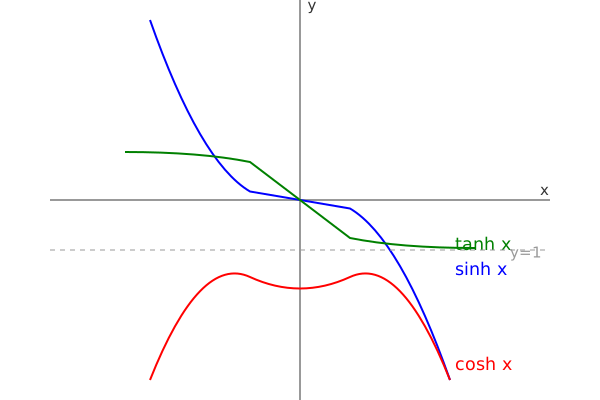
  1. coshx1\cosh x \geq 1 对所有实数 xx 成立
  2. sinhx\sinh x 是奇函数:sinh(x)=sinh(x)\sinh(-x) = -\sinh(x)
  3. coshx\cosh x 是偶函数:cosh(x)=cosh(x)\cosh(-x) = \cosh(x)
  • sinhx\sinh x 类似于 sinx\sin x,但当 x|x| \to \infty 时呈指数增长
  • coshx\cosh x 类似于 cosx\cos x,但最小值为 1 且呈指数增长
  • tanhx\tanh x 有水平渐近线 y=±1y = \pm 1

双曲函数图像

例题 1:解方程 sinhx=3\sinh x = 3

Section titled “例题 1:解方程 sinh⁡x=3\sinh x = 3sinhx=3”

第一步. 利用定义:

exex2=3\frac{e^x - e^{-x}}{2} = 3

第二步.y=exy = e^x,则 ex=1ye^{-x} = \dfrac{1}{y}

y1y=6y - \frac{1}{y} = 6

第三步. 整理为标准形式:

y26y1=0y^2 - 6y - 1 = 0

第四步. 解二次方程:

y=6±36+42=3±10y = \frac{6 \pm \sqrt{36 + 4}}{2} = 3 \pm \sqrt{10}

第五步. 由于 y=exy = e^x,且需要 y>0y > 0

x=ln(3+10)x = \ln(3 + \sqrt{10})

求反函数定义域的步骤:

  1. 检查原函数是否为一一映射(单射)
  2. 如果不是,限制定义域使其成为一一映射
  3. 原函数的值域成为反函数的定义域
  4. 原函数的定义域成为反函数的值域

例如,coshx\cosh x 不是一一映射(因为它是偶函数),所以我们将其定义域限制为 [0,)[0,\infty) 来定义 cosh1\cosh^{-1}

对于六个双曲函数中的每一个,确定:

  1. 该函数在 R\mathbb{R} 上是否为一一映射
  2. 如果不是,需要什么样的定义域限制
  3. 其反函数的定义域
函数一一映射?需要的限制反函数定义域
sinhx\sinh x<x<-\infty < x < \infty
coshx\cosh x否(偶函数)x0x \geq 0x1x \geq 1
tanhx\tanh x1<x<1-1 < x < 1
sechx\operatorname{sech} x否(偶函数)x0x \geq 00<x10 < x \leq 1
cschx\operatorname{csch} x否(渐近线)x<0x < 0x>0x > 0x0x \neq 0
cothx\coth x否(渐近线)x<0x < 0x>0x > 0x<1x < -1x>1x > 1

说明:

  • sinhx\sinh x:严格递增,反函数对所有 xRx \in \mathbb{R} 存在
  • coshx\cosh x:偶函数,限制为 x0x \geq 0,最小值为 1
  • tanhx\tanh x:严格递增,水平渐近线为 y=±1y = \pm 1
  • sechx\operatorname{sech} x:偶函数,限制为 x0x \geq 00<y10 < y \leq 1
  • cschx\operatorname{csch} x:在 x=0x = 0 处有垂直渐近线,需分别考虑 x<0x < 0x>0x > 0
  • cothx\coth x:在 x=0x = 0 处有垂直渐近线,水平渐近线为 y=±1y = \pm 1

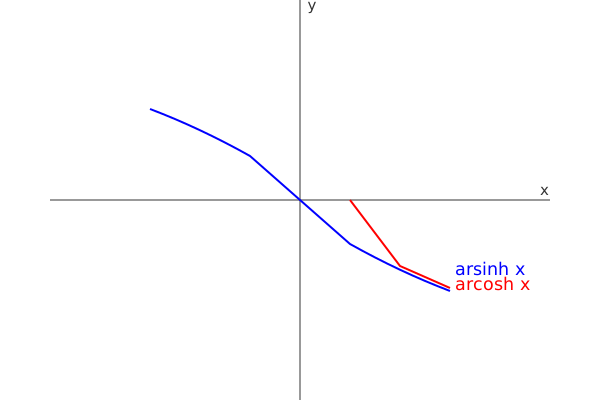
反双曲函数图像

对于任意实数 xx

coshx=cos(ix)\cosh x = \cos(ix)

sinhx=isin(ix)\sinh x = -i\sin(ix)

1. 加法公式:

sinh(x+y)=sinhxcoshy+coshxsinhy\sinh(x+y) = \sinh x \cosh y + \cosh x \sinh y

cosh(x+y)=coshxcoshy+sinhxsinhy\cosh(x+y) = \cosh x \cosh y + \sinh x \sinh y

2. 倍角公式:

sinh(2x)=2sinhxcoshx\sinh(2x) = 2\sinh x \cosh x

cosh(2x)=cosh2x+sinh2x=2cosh2x1\cosh(2x) = \cosh^2 x + \sinh^2 x = 2\cosh^2 x - 1

3. 类勾股恒等式:

1tanh2x=sech2x(基本恒等式除以 cosh2x1 - \tanh^2 x = \operatorname{sech}^2 x \quad \text{(基本恒等式除以 } \cosh^2 x\text{)}

coth2x1=csch2x(基本恒等式除以 sinh2x\coth^2 x - 1 = \operatorname{csch}^2 x \quad \text{(基本恒等式除以 } \sinh^2 x\text{)}

解方程:

7sechxtanhx=57\operatorname{sech} x - \tanh x = 5

答案写成 lna\ln a 的形式,其中 aa 为有理数。

解答:

方法 1:利用定义

7coshxsinhxcoshx=5\frac{7}{\cosh x} - \frac{\sinh x}{\cosh x} = 5

7sinhxcoshx=5\frac{7 - \sinh x}{\cosh x} = 5

7sinhx=5coshx7 - \sinh x = 5\cosh x

7exex2=5ex+ex27 - \frac{e^x - e^{-x}}{2} = 5\frac{e^x + e^{-x}}{2}

14(exex)=5(ex+ex)14 - (e^x - e^{-x}) = 5(e^x + e^{-x})

14ex+ex=5ex+5ex14 - e^x + e^{-x} = 5e^x + 5e^{-x}

146ex4ex=014 - 6e^x - 4e^{-x} = 0

3e2x7ex+2=03e^{2x} - 7e^x + 2 = 0

y=exy = e^x,则:

3y27y+2=0(3y1)(y2)=03y^2 - 7y + 2 = 0 \Rightarrow (3y-1)(y-2) = 0

因此 y=13y = \dfrac{1}{3}y=2y = 2

因此 x=ln ⁣(13)x = \ln\!\left(\dfrac{1}{3}\right)x=ln2x = \ln 2

方法 2:利用 sech2x+tanh2x=1\operatorname{sech}^2 x + \tanh^2 x = 1

(7sechx5)2=tanh2x(7\operatorname{sech} x - 5)^2 = \tanh^2 x

49sech2x70sechx+25=1sech2x49\operatorname{sech}^2 x - 70\operatorname{sech} x + 25 = 1 - \operatorname{sech}^2 x

50sech2x70sechx+24=050\operatorname{sech}^2 x - 70\operatorname{sech} x + 24 = 0

2(5sechx3)(5sechx4)=02(5\operatorname{sech} x - 3)(5\operatorname{sech} x - 4) = 0

sechx=35 或 45\operatorname{sech} x = \frac{3}{5} \text{ 或 } \frac{4}{5}

得到相同答案。

(a)sinhx\sinh xcoshx\cosh x 的指数定义出发,证明:

cosh2x=1+2sinh2x\cosh 2x = 1 + 2\sinh^2 x

解答:

右边=1+2sinh2x=1+2(exex2)2\text{右边} = 1 + 2\sinh^2 x = 1 + 2\left(\frac{e^x - e^{-x}}{2}\right)^2

=1+2(e2x2+e2x4)= 1 + 2\left(\frac{e^{2x} - 2 + e^{-2x}}{4}\right)

=1+e2x2+e2x2= 1 + \frac{e^{2x} - 2 + e^{-2x}}{2}

=2+e2x2+e2x2= \frac{2 + e^{2x} - 2 + e^{-2x}}{2}

=e2x+e2x2= \frac{e^{2x} + e^{-2x}}{2}

=cosh2x=左边= \cosh 2x = \text{左边}

(b) 解方程:

cosh2x3sinhx=15\cosh 2x - 3\sinh x = 15

答案用精确对数表示。

解答:

  1. 利用 (a) 部分:

1+2sinh2x3sinhx=151 + 2\sinh^2 x - 3\sinh x = 15

  1. 整理:

2sinh2x3sinhx14=02\sinh^2 x - 3\sinh x - 14 = 0

  1. 因式分解:

(sinhx+2)(2sinhx7)=0(\sinh x + 2)(2\sinh x - 7) = 0

  1. 因此:

sinhx=2 或 sinhx=72\sinh x = -2 \text{ 或 } \sinh x = \frac{7}{2}

  1. 对于 sinhx=2\sinh x = -2

x=ln(2+(2)2+1)=ln(2+5)x = \ln(-2 + \sqrt{(-2)^2 + 1}) = \ln(-2 + \sqrt{5})

  1. 对于 sinhx=72\sinh x = \dfrac{7}{2}

x=ln ⁣(72+(72)2+1)=ln ⁣(7+532)x = \ln\!\left(\frac{7}{2} + \sqrt{\left(\frac{7}{2}\right)^2 + 1}\right) = \ln\!\left(\frac{7 + \sqrt{53}}{2}\right)

解方程:

5tanhx+7=5sechx5\tanh x + 7 = 5\operatorname{sech} x

每个答案写成 lnk\ln k 的形式,其中 kk 为有理数。

解答:

方法 1:利用指数定义

5exexex+ex+7=10ex+ex5\frac{e^x - e^{-x}}{e^x + e^{-x}} + 7 = \frac{10}{e^x + e^{-x}}

5(exex)+7(ex+ex)=105(e^x - e^{-x}) + 7(e^x + e^{-x}) = 10

5ex5ex+7ex+7ex=105e^x - 5e^{-x} + 7e^x + 7e^{-x} = 10

12ex+2ex=1012e^x + 2e^{-x} = 10

6e2x5ex+1=06e^{2x} - 5e^x + 1 = 0

y=exy = e^x,则:

6y25y+1=0(3y1)(2y1)=06y^2 - 5y + 1 = 0 \Rightarrow (3y-1)(2y-1) = 0

因此 y=13y = \dfrac{1}{3}y=12y = \dfrac{1}{2}

因此 x=ln ⁣(13)x = \ln\!\left(\dfrac{1}{3}\right)x=ln ⁣(12)x = \ln\!\left(\dfrac{1}{2}\right)

方法 2:利用 tanh2x+sech2x=1\tanh^2 x + \operatorname{sech}^2 x = 1

5tanhx+7=5sechx5\tanh x + 7 = 5\operatorname{sech} x

5tanhx5sechx=75\tanh x - 5\operatorname{sech} x = -7

25tanh2x+70tanhx+49=25sech2x25\tanh^2 x + 70\tanh x + 49 = 25\operatorname{sech}^2 x

25tanh2x+70tanhx+49=25(1tanh2x)25\tanh^2 x + 70\tanh x + 49 = 25(1-\tanh^2 x)

50tanh2x+70tanhx+24=050\tanh^2 x + 70\tanh x + 24 = 0

2(5tanhx+3)(5tanhx+4)=02(5\tanh x + 3)(5\tanh x + 4) = 0

tanhx=35 或 45\tanh x = -\frac{3}{5} \text{ 或 } -\frac{4}{5}

利用 tanhx=exexex+ex=45\tanh x = \dfrac{e^x - e^{-x}}{e^x + e^{-x}} = -\dfrac{4}{5}

exexex+ex=45ex=12x=ln ⁣(12)\frac{e^x - e^{-x}}{e^x + e^{-x}} = -\frac{4}{5} \Rightarrow e^x = \frac{1}{2} \Rightarrow x = \ln\!\left(\frac{1}{2}\right)

类似地,对于 tanhx=35\tanh x = -\dfrac{3}{5}

exexex+ex=35ex=13x=ln ⁣(13)\frac{e^x - e^{-x}}{e^x + e^{-x}} = -\frac{3}{5} \Rightarrow e^x = \frac{1}{3} \Rightarrow x = \ln\!\left(\frac{1}{3}\right)

方法 3:利用 sinhx\sinh xcoshx\cosh x

5sinhx+7coshx=55\sinh x + 7\cosh x = 5

5sinhx+7coshx5=05\sinh x + 7\cosh x - 5 = 0

24sinh2x+50sinhx+24=024\sinh^2 x + 50\sinh x + 24 = 0

sinhx=43 或 34\sinh x = -\frac{4}{3} \text{ 或 } -\frac{3}{4}

利用 sinhx=exex2\sinh x = \dfrac{e^x - e^{-x}}{2}

exex2=43ex=13 或 12\frac{e^x - e^{-x}}{2} = -\frac{4}{3} \Rightarrow e^x = \frac{1}{3} \text{ 或 } \frac{1}{2}

得到相同答案。

挑战题(选做):推导悬链线方程

Section titled “挑战题(选做):推导悬链线方程”

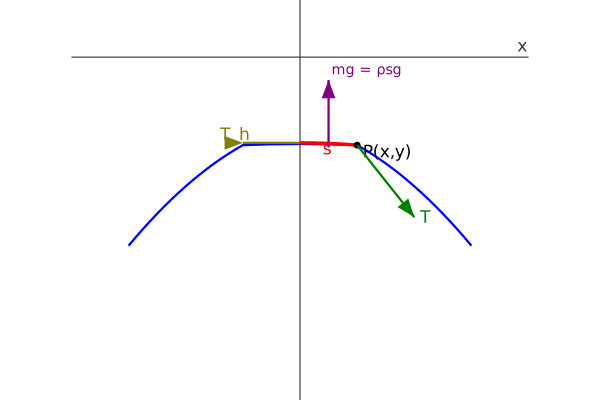
考虑一根在自身重力作用下悬挂的柔性链条。我们将推导其形状——著名的悬链线 y=acosh ⁣(xa)y = a\cosh\!\left(\dfrac{x}{a}\right)

建立坐标系:

  • xx 轴水平,yy 轴竖直向上
  • ρ\rho = 链条单位长度的质量
  • ss = 从底部到点 P(x,y)P(x,y) 的弧长
  • TT = 点 PP 处的张力
  • ThT_h = 张力的水平分量(沿链条保持恒定)

悬链线设定图

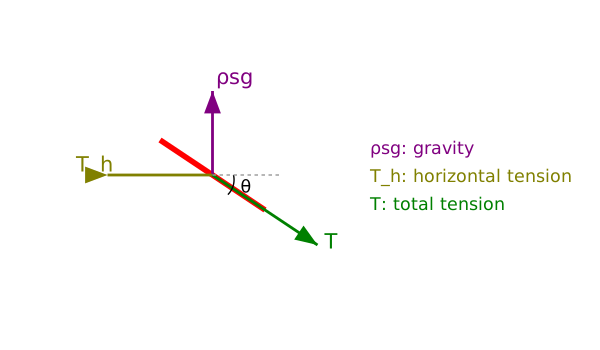
对于链条的一小段:

  • 小段质量 = ρs\rho s(与弧长成正比)
  • 张力 TT 沿曲线切线方向
  • ThT_h 保持恒定(关键洞察!)
  • θ\thetaTT 与水平方向的夹角

力分析图

由力平衡:

Tsinθ=ρsg(竖直力平衡)T\sin\theta = \rho s g \quad \text{(竖直力平衡)}

Tcosθ=Th(水平力平衡)T\cos\theta = T_h \quad \text{(水平力平衡)}

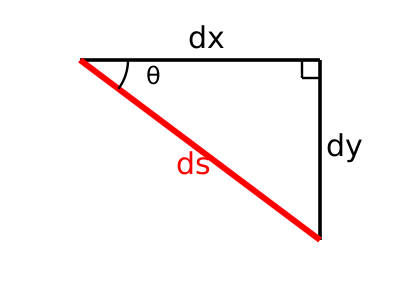
微分三角形

对于一小段:

sinθ=dyds\sin\theta = \frac{dy}{ds}

cosθ=dxds\cos\theta = \frac{dx}{ds}

将力方程相除:

tanθ=ρsgTh=dydx\tan\theta = \frac{\rho s g}{T_h} = \frac{dy}{dx}

a=Thρga = \dfrac{T_h}{\rho g},则:

dydx=sa\frac{dy}{dx} = \frac{s}{a}

由微分三角形:

ds2=dx2+dy2因此dsdx=1+(dydx)2ds^2 = dx^2 + dy^2 \quad \text{因此} \quad \frac{ds}{dx} = \sqrt{1 + \left(\frac{dy}{dx}\right)^2}

dydx=sa\dfrac{dy}{dx} = \dfrac{s}{a} 关于 xx 求导:

d2ydx2=1adsdx=1a1+(dydx)2\frac{d^2y}{dx^2} = \frac{1}{a}\frac{ds}{dx} = \frac{1}{a}\sqrt{1 + \left(\frac{dy}{dx}\right)^2}

我们已推导出微分方程:

d2ydx2=1a1+(dydx)2\frac{d^2y}{dx^2} = \frac{1}{a}\sqrt{1 + \left(\frac{dy}{dx}\right)^2}

问题: 尝试用以下提示解这个方程:

  1. pp 替换 dydx\dfrac{dy}{dx}
  2. arsinh(p)\operatorname{arsinh}(p) 的导数是 11+p2\dfrac{1}{\sqrt{1 + p^2}}。(我们将在第三章学习这个。你也可以利用 arsinh(p)\operatorname{arsinh}(p) 的定义自行证明。)
  3. sinh(x)\sinh(x) 的导数是 cosh(x)\cosh(x)。(我们也将在第三章学习这个。你也可以利用 sinh(x)\sinh(x)cosh(x)\cosh(x) 的指数定义自行证明。)

解答:

  1. 利用关于 arsinh(p)\operatorname{arsinh}(p) 的提示,可以直接积分:

arsinh(p)=xa+C1\operatorname{arsinh}(p) = \frac{x}{a} + C_1

  1. 因此:

p=sinh ⁣(xa+C1)p = \sinh\!\left(\frac{x}{a} + C_1\right)

  1. 由于 p=dydxp = \dfrac{dy}{dx},可以将 C1C_1 吸收到坐标原点的选择中:

dydx=sinh ⁣(xa)\frac{dy}{dx} = \sinh\!\left(\frac{x}{a}\right)

  1. 再次积分:

y=acosh ⁣(xa)+C2y = a\cosh\!\left(\frac{x}{a}\right) + C_2

这是悬链线的一般方程,其中:

  • aa 决定曲线的”尺度”
  • C2C_2 将曲线沿竖直方向平移
  1. 证明任意点处的张力为:

T=Thcosh ⁣(xa)T = T_h\cosh\!\left(\frac{x}{a}\right)

  1. 研究: 为什么悬索桥呈抛物线形状而不是悬链线?(提示:考虑荷载如何分布)